


Merry Christmas, my friends and family.
It’s early morning here on the Eastern Shore, and I’m writing this from a small wooden desk in my bedroom that sits in front of a wide double window overlooking my backyard. I’m two stories up, and my view from here is magical. I wish you could see it.
Maybe others would find my view ordinary. It’s a small patch of a suburban landscape – less than a half an acre. It’s framed by a wooden privacy fence. There’s the quiet geometry of a circular meditation garden with boxwoods making a cross in the center. There’s a wooden trellis at the entry of that garden with bare climbing rose canes clinging to the sides. The flower beds have all gone dormant, and the fountain is dry. The birdhouses have been abandoned for the winter, and a few chickadees are at the feeders. I’m not bothered by the disarray of overturned trashcans, plastic toys, or the trampoline in my neighbor’s backyard, which is also visible. They are inanimate reminders of the lovely people who live there and the children who play in that yard. There’s a big, fat, gray tomcat creeping like a lion atop the block wall that marks the boundary between my little sanctuary and the grocery store next door. Nothing special about this view to those who don’t live here.
The magic in this landscape comes from the Loblollies. These are the tall, regal yellow pines common to the sandy, flat Eastern Shore. They rise from the earth like Roman columns, with bare trunks reaching seventy, eighty, sometimes ninety feet high. Their fringy growth is mostly at the top – like a palm tree. As the Loblollies climb, they bend and weave, fighting for the light, thus creating this canopy of green set against a barely visible blue sky. When the wind blows hard, their massive trunks sway like dancers, shaking loose pine needles that flutter down like tiny blessings from the tree spirits. Sometimes I try to count the number of trees I can see from my window. Twenty-two? Thirty-three? Forty-one? They’re sneaky, those Loblollies. Always hiding behind each other – moving about so that one loses count.
So here I sit, in the quiet benediction of the Loblolly Pines outside my window – inspired, as I am each morning when I survey their beauty. It’s not a water view, or a mountain range, or an expansive patchwork of gentle farm fields, or some other natural awesomeness that so many crave as a view from their windows. But it’s my view, and it’s perfect for me.
I led two tours to mystical places in Ireland this year. Yes – Ireland again. While my heart holds a deep affection for Scotland, England, Wales, and Brittany, no land feels quite as saturated with the sacred as Ireland. Despite being roughly the size of Indiana or Maine, Ireland possesses a staggering density of ancient and Medieval monuments. Acre for acre, Ireland has more monuments than any other nation on Earth for its size, surpassed only by the island of Malta. (Rhode Island is 8 times bigger than Malta.) There are 150,000 sites that include ring forts, standing stones, monastic ruins, castles, high crosses, stone circles, and ancient tombs, some dating back 7000 years, and most of the sites are associated with some type of spiritual element or ritual. Stand anywhere in Ireland, and you won’t be but a few miles from some ancient remnant of the past. And these thin places ignite creativity in their local populations. For centuries, poets, singers, musicians, and dancers have translated Ireland’s mystery into art. Artists continue the challenging work of manifesting the unique, soul-stirring power held within the Irish landscape.
One must wonder why the Irish never moved these relics. Other countries in Europe moved them about, reused the stones in buildings, tore down ruins to make way for new development, and Ireland has also done that to a certain extent. But there is this deep respect – some would call it superstition – embedded in the Irish people about their land. Some of the old farmers will tell you that all this “fairy stuff” is nonsense. But you won’t see those farmers cutting down a lone hawthorn tree in their field. In a land that oozes a spiritual energy that shapes its population, the Irish and their sacred landscape are inseparable. It is this deep-rooted connection that draws me back year after year. I find myself continually transformed by these “thin places”—those rare, hallowed thresholds where the veil between this present world and that mystical, spiritual, magnetic “other world” is thin. And so, I happily return … year after year.
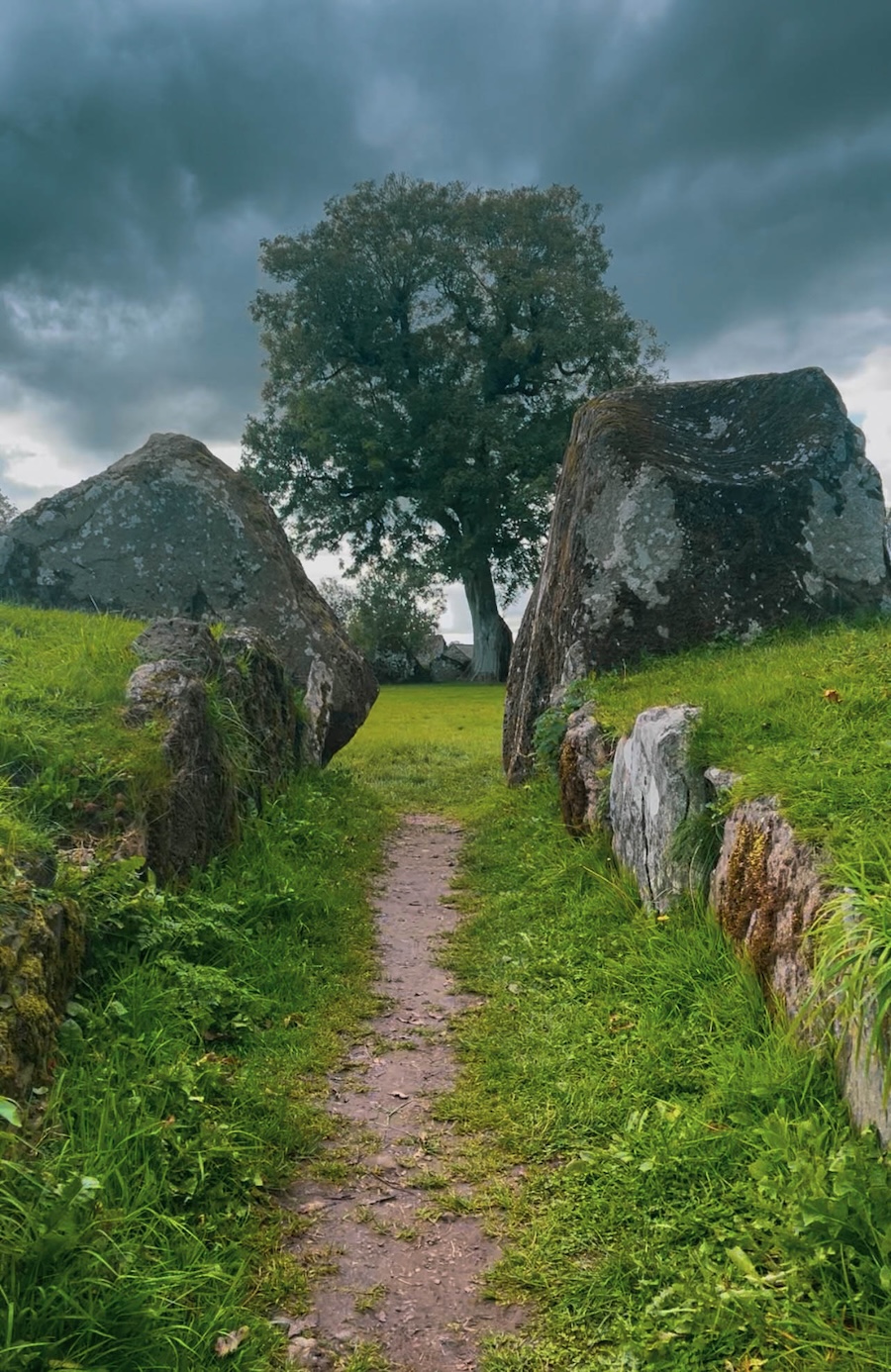
The images shown here are two of my favorite thin places. They are like old friends that I long to see again when I return to Ireland. In the image above is the entrance to the Grange Stone Circle in County Limerick. This is the largest stone circle in Ireland, covering about an acre of land with 113 contiguous stones arranged in a perfect circle. The entrance into the circle (shown in the photo) has an opening aligned with the sunrise of the Summer Solstice, where for the last 4000 years the sun has risen on June 21st, pouring itself right through that entrance, filling the circle with light – marking the longest day of the year. One can simply pull off the main road into a small parking area and walk right up to this circle. Free access to anyone who wants to be mesmerized.
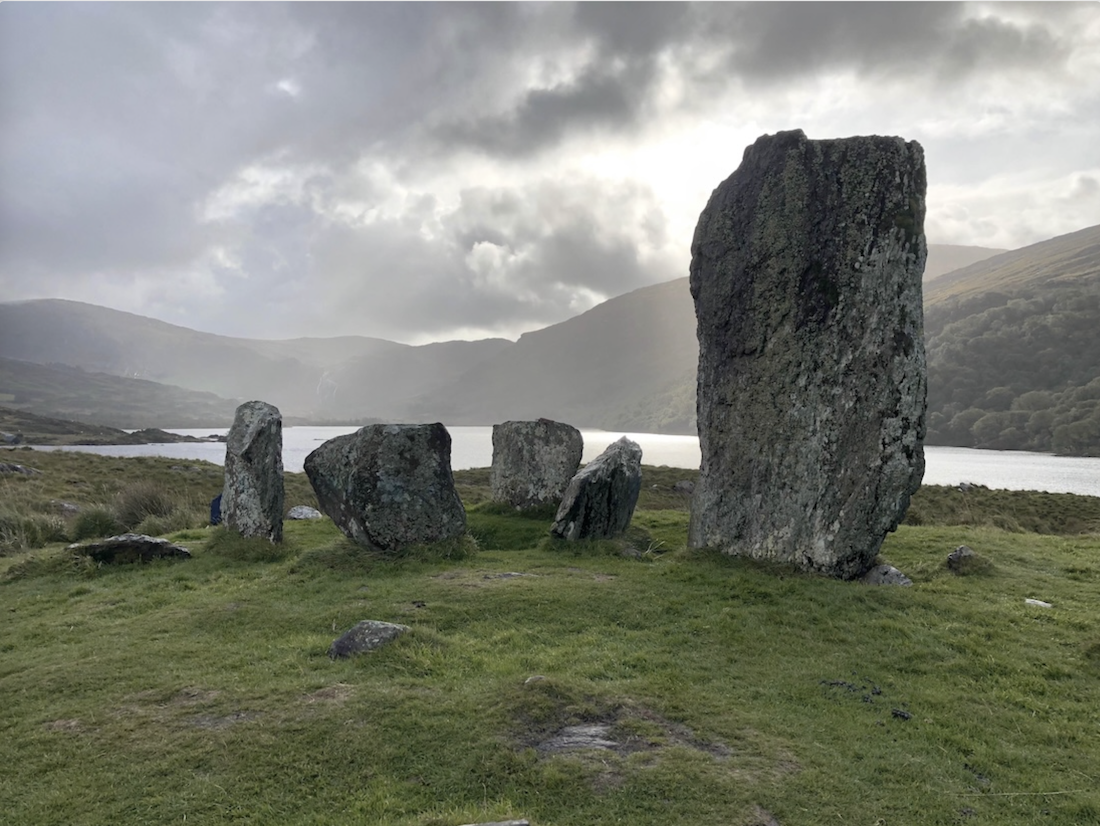
The image below this paragraph is of a much smaller stone known as Uragh (oo-rah). No one ever forgets the first time they see Uragh. Reaching it requires a 20-minute descent down winding roads into a vast mountain bowl marked by waterfalls that empty into two side-by-side lakes at the bottom. Uragh, ever invisible, sits on a rise between the lakes. Once the road ends, a ten-minute trek down a stony path leads across a footbridge over rippling water and a gateway to the final incline. And at the crest — there it is. Uragh appears in the mist, standing solitary where the ancestors put it thousands of years ago. Its name means The Place of the Yew Trees – a nod to the sacred tree of the pre-Christian Celts, which likely occupied the site long ago. Uragh’s stones are aligned with the sun and moon at Midsummer. Four small stones and one massive, ten-foot sentinel still stand in silence, holding the memories of a people who once processed as pilgrims to bury their dead, honor their ancestors, and beg the creator for favor. Now, the mountains, lakes, and occasional pilgrim are Uragh’s only company.
The great poet and scholar, N. Scott Momaday from the Kiowa Nation, wrote:
Sacred places are the truest definitions of the earth. They stand for the earth immediately and forever; they are its flags and its shields. If you would know the earth for what it really is, learn it through its sacred places.
I’ll be back in Ireland again this year in the Spring and Fall to discover more thin places. I’d welcome you to join me.
While I’m grateful to have been healthy in 2025, the mental stress of what’s going on in the world has taken a toll. Perhaps I’m too close to it. Just this week in my little town, a Latino mother dropped her little girl off at school, and ICE agents pulled her – just her – from the car and led her off for deportation. No notice to the family. No worry about the child who will be crying – missing her mama, who never said goodbye. Evidently, the woman’s ex-husband, who was fighting for custody, turned her in. It seems that morality has been privatized. People adopt their own version of what is right and wrong. We’ve lost a common belief. The great writer and journalist, Walter Littman, wrote, “If what is wrong depends on what each individual feels, then we are outside the bounds of civilization.”
It seems fitting to ponder these current troubles during Christmas, because though the Christmas message is one of salvation and promise, that theme only emerges at the end of a very sad story. And whether one is Christian, Jewish, Muslim, or an atheist, that story still echoes through the ages with a universal truth. Who can’t relate? Who was never an outsider, rejected, lonely, isolated? Here is a young couple – she is pregnant. It’s not his child. He loves her anyway. They fear shame from their peers. They don’t have a high social standing. And when traveling outside their home, she unexpectedly goes into labor. They are in dire need of a place to stay and have that baby. They are strangers in a strange place. No one has room. One door closes after another, until finally someone offers a barn. So, the baby is born outside the shelter of a home, in a place shared with livestock. The mother doesn’t even have a shirt to clothe him, and she must lay him in a feeding trough. There in that humble stable, two seemingly friendless people bring forth their precious child into an uncaring world, where no one “saw” them. They were but a passing inconvenience to innkeepers who shut them out. It was so easy to turn a blind eye.
That was the sad part of the story. Perhaps morality was privatized back then, too.
If masked men with guns pulling a helpless mother from her car – forcing her to abandon her child isn’t wrong, then nothing is wrong. If voting to take away health care from millions, leaving them no other affordable option, isn’t wrong, then nothing is wrong. If covering up the criminal activity of the powerful isn’t wrong, then nothing is wrong. If cutting off foreign aid with no warning, knowing that it will cause thousands of vulnerable people to starve, isn’t wrong, then nothing is wrong.
But there is hope. The ending of the Christmas story is the best part. In those hours in the stable when sadness, rejection, and fear put that couple in such a lonely and scary place, the light of salvation was born. The promise that things would get better, that every tear would be wiped away, that death was not the end, was manifested in the birth of that child. Is it possible that our greatest treasure is sometimes masked in what we reject and find deplorable? I know I’ve been guilty of being blind to where the treasure lies. In the end, we are all made in the image of the Divine. We are all connected as we wander through this wilderness we call life – learning how to find the real treasure. And eventually we will get to the promised land. I want to get there with an open heart, a heart of mercy.
I have a quote on my bulletin board above my desk. It was written by the French philosopher, Simone Weil. It reads:
Attention is the rarest and purest form of generosity.
It’s a fitting message for Christmas, when we can get so busy trying to make things perfect. I may not be able to change public policy or impact human suffering in the world, but I can pay attention to strangers and friends that cross my path. I can “see” them like those who saw the Holy Family in the Christmas story. And think…who brought the gifts? The wise men who came from another land, the drummer boy who could only offer the beat of his drum, the shepherd who had nothing to give but a lamb, the animals who warmed the baby with their breath, the angels who joyfully sang. It wasn’t the gift that mattered. It was the intent of the cheerful giver.
What can I give? I can give my attention – fully. In the end … all of us yearn to be seen.
A word about this Christmas letter. I’ve been writing these for twenty-some years. Some people make cookies; some people sing carols. I’m a writer. I write letters. And thought I can’t the individuals who actually read these long missives, before I click “Publish,” I mentally imagine those who read it, and pray for them.
So, I pray for you. I pray that you will find happiness and health in the new year, that you will feel abundance flow into your lives. I pray that all of your prayers will be answered.
Know that I am grateful for you. Merry Christmas.

written on December 19, 2025





Lisa Holland
December 27, 2025Beautiful, thank you Mindie!
Gale Collins
December 27, 2025I always look forward to your Christmas letters every year. Thank you for continuing them. Merry Christmas.
Gale